New research: Nuts and male fertility

New research: Nuts and male fertility
Research continues to highlight the role of diet in reproductive health, with a new study finding a link between nut consumption and improved sperm quality (1).
The study, involving 222 healthy young men aged 18 to 40 years, found higher nut consumption (≥7 servings/week) to be linked with greater total sperm count and sperm concentration, compared to lower consumption (<3 servings/week).
In addition, men with higher nut consumption had 75% lower odds of abnormal sperm motility.
The study also found that each additional 30g daily serving of nuts was linked to incremental improvements in these measures, suggesting that even modest increases in nut intake may offer benefits.
The research was recently published in the scientific journal Andrology.
Consuming nuts regularly (≥7 servings per week, or around 30g per day) may support improved sperm parameters in healthy men. This aligns with the general international recommendation for nut consumption (≥30g/day) (1).
About the study
Participants were grouped by how many 30g servings of nuts they ate each week: <3, ≥3 to <7, or ≥7. Total nut intake included almonds, pistachios, walnuts, and ‘other nuts’ (like cashews, hazelnuts, Brazil nuts, and peanuts).
Researchers measured key markers of sperm health, including count, concentration, movement, vitality, and shape.
They also modelled the impact of replacing one daily serve of nuts (30g) with one daily serving of a typical snack food, such as potato crisps (50g) or pastries (50g).
Did you know? Fertility problems affect about one in nine Australian couples of reproductive age, and in nearly half of these cases, this is due to fertility issues experienced by men (2).
The key findings
- Higher nut consumption (≥ 7 servings/week) was linked with greater total sperm count and concentration, compared to lower nut consumption.
- Higher nut intake was further linked to a lower likelihood of abnormal sperm motility and overall semen abnormalities.
- Replacing nuts with potato crisps or pastries was associated with poorer sperm parameters.
The researchers say the benefits of nuts likely stem from their anti-inflammatory and antioxidant effects. For instance, antioxidants found in nuts may protect sperm cells from oxidative stress, supporting DNA integrity and normal sperm function.
Nuts contain bioactive compounds, such as antioxidants (vitamin E, vitamin C, selenium, zinc, and polyphenols), omega-3 fatty acids, dietary fibre, and amino acids like L-arginine, which are thought to play a crucial role in supporting male reproductive function (1,3).
Nuts and male fertility: Further evidence
Nuts are the only food group that has been shown, in randomised controlled trials, to improve sperm quality in healthy reproductive-age men (1).
The FERTINUTS study, found that adding 60g/day of mixed nuts for 14 weeks, significantly improved sperm quality parameters in healthy men following a Western-style diet (4).
Another intervention trial found improvement in sperm vitality, motility, and morphology after supplementing the diet with 75g/day of walnuts, over 12 weeks (5).
But unlike these two randomised controlled trials, which supplemented the diet with 60–75g/day of nuts under controlled conditions, this new study focussed on habitual nut consumption within a regular diet.
Adding to this, a recent preconception cohort study (6) reported that consumption of ≥25g/day of nuts and seeds was associated with increased male fecundability (or the impact of a man’s fertility on the probability of conception).
Did you know? Research consistently shows that overall dietary patterns are stronger predictors of sperm quality than any single food. Healthy dietary patterns, such as the Mediterranean diet, have been extensively studied in relation to fertility and have been associated with improved sperm quality (7).
The bottom line
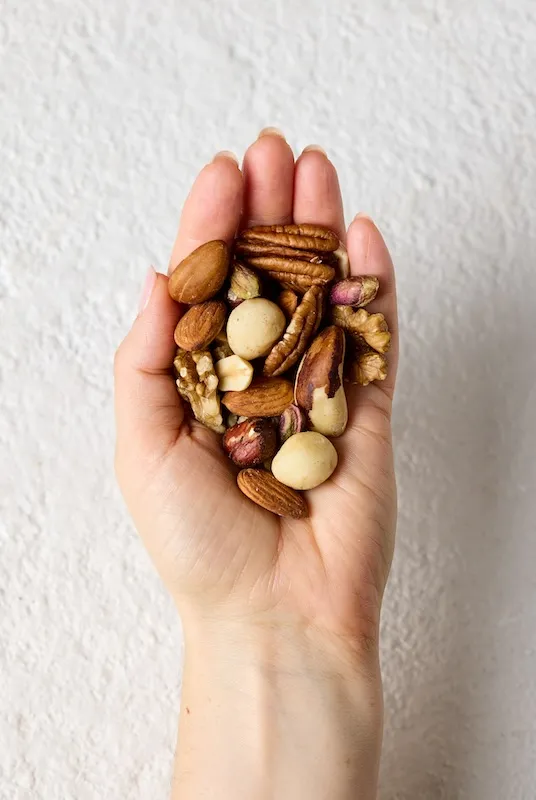
Regular nut consumption may be linked to improved sperm parameters in healthy men – key markers of male fertility. Enjoy a handful of mixed nuts daily, for a variety of ‘fertility-friendly’ nutrients, and swap in nuts instead of less-nutritious snacks. A simple, practical way to support both overall and reproductive health!
Due to their nutritional profile, nuts have potential to promote successful reproductive outcomes (3).
References
- Dávila-Córdova, E., et al. Nut consumption and sperm quality in healthy men: Results from the Led-Fertyl Study. Andrology, 2026. e70204. https://doi.org/10.1111/andr.70204
- Australian Government. Department of Health, Disability and Ageing. About Reproductive Health. Accessed 13 April 2026. Available at: https://www.health.gov.au/topics/reproductive-health/about#reproductive-health-in-australia
- Cardoso, BR., et al. Nut consumption and fertility: A systematic review and meta-analysis. Adv Nutr, 2024. 15(1):100153.
- Salas-Huetos, A., et al. Effect of nut consumption on semen quality and functionality in healthy men consuming a Western-style diet: A randomized controlled trial. Am J Clin Nutr, 2018. 108(5):953-62.
- Robbins, WA., et al. Walnuts improve semen quality in men consuming a western-style diet: randomized control dietary intervention trial. Biology of Reproduction, 2021. 87(4):1-8.
- Schipper, MC., Dietary intake of polyunsaturated fatty acids, their food sources and fertility in females and males: A preconception prospective population-based cohort study. Am J Clin Nutr, 2025. 121(6):1354-64.
- Agarwal, R., et al. Mediterranean diet, semen quality, and medically assisted reproductive outcomes in the male population: A systematic review and meta-analysis. Adv Nutr, 2025. 16(8):100454.

For information purposes only. ©2026 Nuts for Life