Nuts and the Health Star Rating

Nuts and the Health Star Rating
Earlier this year, Food Ministers from Australia and New Zealand agreed to move toward mandatory Health Star Ratings (HSR) on all packaged foods sold in Australia and New Zealand. As a result, Food Standards Australia New Zealand (FSANZ) is now calling for submissions (Proposal P1067) in this area.
| Nuts for Life supports FSANZ’s assessment that a mandatory Health Star Rating (HSR) system has the potential to better support healthier food choices than a voluntary system. However, a move towards mandatory HSR should be coupled with a targeted review by FSANZ, aimed at strengthening the existing HSR system, to reinforce dietary guidance and nutrition evidence. |
An opportunity to strengthen the HSR
The HSR system is a valuable front-of-pack labelling tool that helps consumers compare packaged foods. Like all nutrient profiling systems, it must simplify complex nutrition evidence into a practical algorithm based on selected nutrients and food components.
Since 2014, when the HSR was introduced, the nutrition evidence base has increasingly highlighted the importance of whole foods, dietary patterns, food matrices, nutrient quality, bioactive compounds, and food processing.
This highlights the need for periodic review of nutrient profiling systems, like the HSR.
A move towards mandatory HSRs creates an important opportunity to consider whether the current system appropriately recognises plain, unsalted nuts – a nutrient-dense, minimally-processed core food, recommended in dietary guidelines for their role in healthy dietary patterns, and their established health benefits.
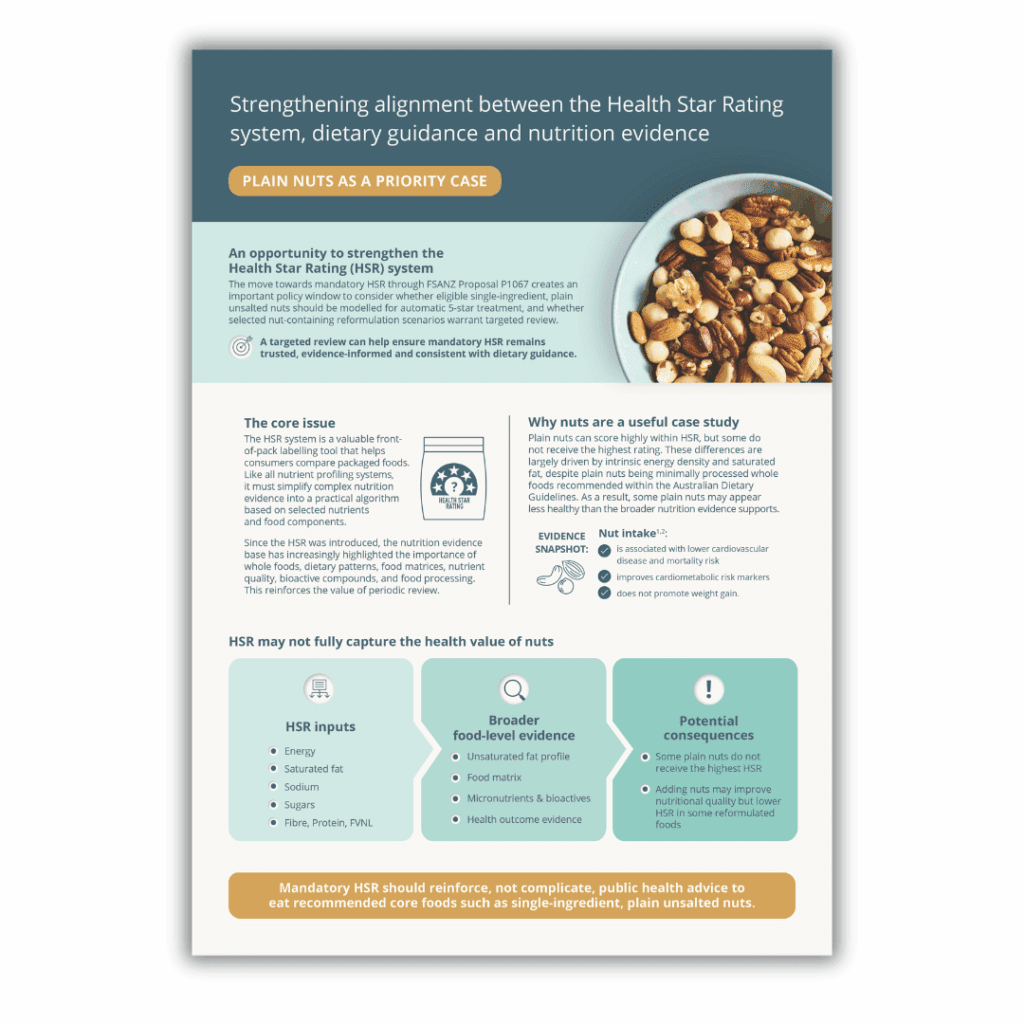
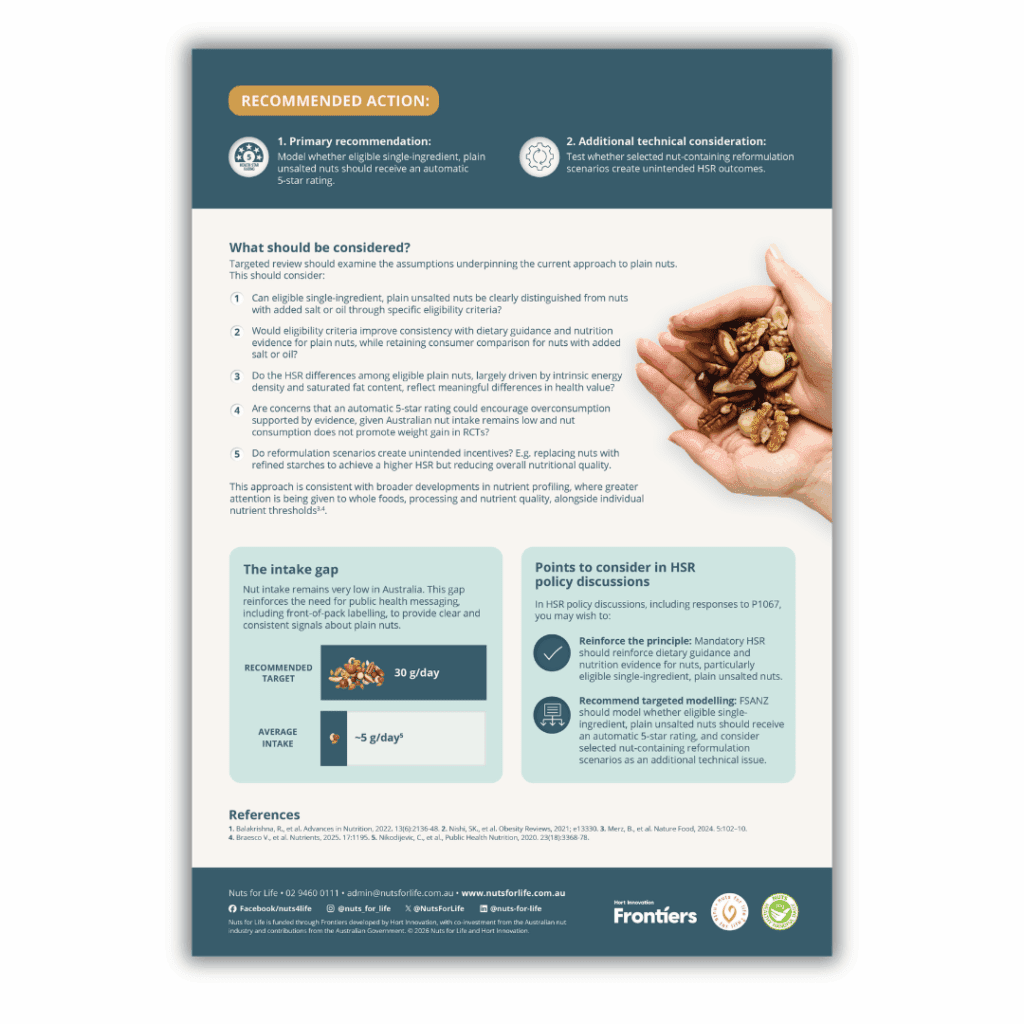
| Nuts for Life would like FSANZ to: 1. Model whether eligible, single-ingredient, plain unsalted nuts should receive an automatic 5-star rating 2. Test whether selected nut-containing reformulation scenarios create unintended HSR outcomes. |
Nuts as a useful case study
Nuts are a core food recommended in the Australian Dietary Guidelines. Regular nut intake is associated with a lower risk of cardiovascular disease and mortality, improved cardiometabolic health markers, and does not contribute to weight gain (1,2).
Plain nuts can score highly within the HSR, but some do not receive the highest (5 star) rating.
These differences are largely driven by intrinsic energy density and saturated fat – despite nuts also providing unsaturated fats, micronutrients, and bioactive compounds within a complex food matrix.
As a result, some plain nuts may appear less healthy than the broader nutrition evidence supports.
In addition, adding nuts may improve the nutritional quality, but lower the HSR, in some reformulated foods. For example, using data from the FSANZ food composition tables, the HSR of wholemeal bread, which includes 20% walnuts, would be 4 stars, 0.5 stars lower than a plain wholemeal bread.
| HSR captures | May not be captured | Potential consequence |
| Energy Saturated fat Sodium / Sugars Fibre / Protein / FVNL* | Unsaturated fat profile Food matrix Micronutrients & bioactives Health outcome evidence | Some plain nuts do not receive the highest HSR Adding nuts to some reformulated foods can lower their HSR |
*FVNL = fruit, vegetable, nut and legume content
Nut intake remains very low in Australia, averaging around 5g/day (3) compared with the commonly recommended 30g/day target. This gap reinforces the need for public health policy, including front-of-pack labelling, to provide clear and consistent signals about plain nuts.
As the HSR system moves towards mandatory implementation, ensuring its ongoing alignment with nutrition evidence and dietary guidelines, particularly for core foods like nuts, will support the credibility of the HSR and its public health impact.
References
- Balakrishna, R., et al. Consumption of nuts and seeds and health outcomes including cardiovascular disease, diabetes and metabolic disease, cancer, and mortality: An Umbrella Review. Adv. Nutr, 2022. 13: 2136–48.
- Nishi, SK., et al. Are fatty nuts a weighty concern? A systematic review and meta-analysis and dose-response meta-regression of prospective cohorts and randomized controlled trials. Obes Rev, 2021. 22, e13330.
- Nikodijevic, CJ., et al. Nut consumption in a representative survey of Australians: A secondary analysis of the 2011-2012 National Nutrition and Physical Activity Survey. Public Health Nutr, 2020. 23: 3368–78.

For information purposes only. ©2026 Nuts for Life