
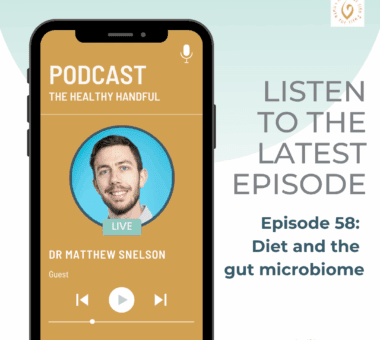
Episode 58 – Diet and the gut microbiome
March 2026. Listen here: And available everywhere you listen to podcasts: https://pod.link/thehealthyhandful About this episode In this episode, we speak…

February 2026.
And available everywhere you listen to podcasts: https://pod.link/thehealthyhandful

Just like the rest of our body, our brain is deeply influenced by our lifestyle. The quality of our sleep, how often we move, and what we eat, all play a powerful role in shaping brain health.
To function at its best, the brain relies on a wide variety of nutrients, which means dietary diversity matters. Growing research shows that improving our eating patterns and incorporating a broad range of whole, nutrient-dense foods can lead to meaningful improvements in mood and overall mental wellbeing.
In this episode, originally recorded in 2022, we explore the science behind the food and mood connection with Dr Wolf Marx from the Food & Mood Centre at Deakin University.
Key take-outs:
A/Prof Wolfgang Marx is the Deputy Director of the Food & Mood Centre. A Senior Research Fellow and NHMRC Emerging Leader, Wolfgang has been a key member of the Centre since 2018, leading major projects in Nutritional Psychiatry. His work spans high-impact systematic reviews, clinical trials on probiotics and nutraceuticals, and international clinical and research guidelines. As President of the International Society for Nutritional Psychiatry Research, he has also played a key role in advancing the field at a global level.

Effect of Mediterranean diet on mental health outcomes: A systematic review
Sign up to NutENews
Follow us on Instagram, Facebook and LinkedIn
Credits
Host: Belinda Neville
Contact us
Published February 24, 2026

For information purposes only. ©2026 Nuts for Life
March 2026. Listen here: And available everywhere you listen to podcasts: https://pod.link/thehealthyhandful About this episode In this episode, we speak…

The body of evidence about nuts and mental health continues to grow, with new local and international research papers regularly…
January 2026. Listen here: And available everywhere you listen to podcasts: https://pod.link/thehealthyhandful About this episode Nutrition is a fundamental pillar…
Be sure to follow us for great recipes,
Nut inspirations and fun facts
For up to date information & the latest research articles