
Food and mood [re-release]
February 2026. Listen here: And available everywhere you listen to podcasts: https://pod.link/thehealthyhandful About this episode Just like the rest of…

The body of evidence about nuts and mental health continues to grow, with new local and international research papers regularly published.
The association between nut consumption and risk of depressive symptoms: A meta-analysis of observational studies. (Kim et al, 2025).
This meta-analysis, of seven observational studies, involving 70,136 participants, found that higher nut consumption was linked with a lower risk of depressive symptoms. This association was significant when nut intake reached at least three serves per week. Compared with <1 time/week, nut consumption at ≥3 times/week was associated with a 25% lower risk of depressive symptoms (SRRs = 0.75, 95% CIs, 0.67–0.85; p < 0.001). The inverse relationship was not significant for 1 to <3 times/week of nut consumption, suggesting a possible threshold effect. The protective benefits could be attributed to the diverse bioactive nutrients found in nuts, including omega-3 fatty acids, magnesium, and vitamin E.
Does the evidence support a relationship between higher levels of nut consumption, lower risk of depression, and better mood state in the general population? A systematic review. (Fernandez-Rodriguez et al, 2022).
This systematic review, of 10 previously-published studies, involved more than 66,000 people, across five countries. Six studies looked at nut consumption and depression, and four focussed on nuts and mood state. The researchers concluded: “Higher nut consumption is associated with a reduced risk of depression and better mood state in the general population”. They acknowledge that further studies, with larger sample sizes and longer follow-up periods, will add to knowledge in this area.
Effects of the MIND diet on the cognitive function of older adults: A systematic review. (Kim et al, 2025).
This systematic review, with a total of 17,201 older adults, examined the impact of the MIND diet on cognitive function. Of the 11 included studies, nine found that higher MIND diet scores were linked with better cognitive function, enhanced cognitive resilience, and a reduced risk of early-onset dementia. The MIND diet score comprises 15 components: 10 brain-healthy food groups (eg. green leafy vegetables, nuts, legumes, whole grains, fish, poultry, and olive oil) and 5 food groups to be limited (eg. red meat, butter, cheese, sweets, and fried foods). Additional systematic reviews and large randomised controlled trials, particularly in Asian populations, are needed.
Effect of Mediterranean diet on mental health outcomes: A systematic review. (Hussen Kabthymer et al, 2025).
This systematic review, of 104 articles (88 observational and 16 interventional studies), highlights a growing body of evidence linking the Mediterranean diet (MedDiet) with favourable mental health outcomes. Adherence to the Med Diet was associated with reduced depressive and anxiety symptoms, lower perceived stress, and improved quality of life and overall well-being, both in healthy individuals and those with comorbidities, and across diverse geographical settings. Possible mechanisms involved include the antioxidant and anti-inflammatory potential of the MedDiet, and its effect on gut microbiota.
Diet and the risk of unipolar depression in adults: A systematic review of cohort studies. (Sanhueza et al, 2013)
A diet rich in folate, omega-3 fatty acids, olive oil, fish, fruits, vegetables and nuts may have a protective effect against depression, although the evidence is currently insufficient to establish an independent protective role for nuts alone.
The association between dietary exposures and anxiety symptoms: A prospective analysis of the Australian Longitudinal Study on Women’s Health Cohort. (Lee et al, 2025).
This study examined the association between dietary exposures and anxiety and depression in two cohorts of Australian women born between 1973 and 1978, and between 1946 and 1951. It used data from 20,307 women enrolled in the Australian Longitudinal Study on Women’s Health. Higher intake of vegetables, nuts, seeds, legumes, fibre, milk, and calcium were associated with decreased anxiety and depression, while higher intake of processed meat and sodium was linked to an increased risk of these conditions. Specific to nuts and seeds, each 30g serving increase was linked with a 7% lower risk of anxiety, and a 24% lower risk of depression.
Adherence to the EAT-Lancet diet and incident depression and anxiety. (Lu et al, 2024).
This study investigated the prospective association of adhering to the EAT-Lancet reference diet with depression, anxiety, and their co-occurrence, in 180,446 UK Biobank participants. Over 11.62 years of follow-up, participants within the group with the highest adherence to the Eat-Lancet diet had lower risks of depression, anxiety, and their co-occurrence, compared to those in the lowest adherence group. It suggests that following the EAT-Lancet Planetary Health Diet may be linked with a reduced risk of depression and anxiety.
Adherence to a Mediterranean diet is inversely associated with anxiety and stress but not depression: A cross-sectional analysis of community-dwelling older Australians. (Allcock et al, 2024).
This cross-sectional analysis of 294 older Australians (≥ 60 years) showed that adherence to a Mediterranean diet (MD) was inversely associated with severity of symptoms related to anxiety and stress. However, adherence to a MD was not related to depressive symptoms. In addition, it found that certain individual dietary components within a MD, including fruit, nuts, legumes, and a low consumption of sugar-sweetened beverages (<250mL per day), were inversely associated with the severity of symptoms related to anxiety and stress.
Adolescent dietary patterns derived using principal component analysis and neuropsychological functions: A cross-sectional analysis of Walnuts Smart Snack cohort. (Ayala-Aldana et al, 2024).
Results of this cross-sectional analysis suggest that dietary patterns that include “nuts” and “low consumption of calorie-dense foods” could be beneficial to neuropsychological outcomes related to brain maturity during adolescence. Adherence to the “nuts” dietary pattern showed a protective association with Attention Network Test (ANT) impulsivity index. ANT impulsivity index is used in identifying mental health changes, behavioural regulation, and risk-taking behaviour in the adolescent population. While this study provides valuable insights, further research is needed.
Nut consumption and depression: Cross-sectional and longitudinal analyses in two cohorts of older adults. (Fernández-Rodríguez et al, 2023).
This observational research, investigating two cohorts of older Spanish adults (≥65 years), found nut consumption to be linked with a lower risk of depression. In the meta-analysis of cross-sectional results from the two studies, compared to consuming <1 serving (30g) of nuts/week, the odds ratio for depression was 0.90 (0.64, 1.16) for consuming 1 to <3 servings/week and 0.92 (0.70, 1.13) for consuming ≥3 servings/week. The corresponding figures for the longitudinal results were 0.90 (0.41, 1.38) and 0.66 (0.35, 0.97).
Nut consumption is associated with a lower risk of depression in adults: A prospective analysis with data from the UK Biobank cohort. (Bizzozero-Peroni et al, 2023).
This study analysed whether nut consumption is linked with the risk of depression. It involved 13,504 middle-aged and older UK-based adults, without depression at baseline, who were tracked over an average of 5.3 years – by which time 1,122 (8.3%) cases of depression were identified. Compared with no nut consumption, the daily consumption of >0 to 1 serve of 30g of nuts/day was linked with a 17% lower risk of depression, regardless of all potential confounders considered.
A high polyphenol diet improves psychological wellbeing: The Polyphenol Intervention Trial. (Kontogianni et al, 2020).
This intervention study assessed the effect of a high polyphenol diet (HPD), compared to a low polyphenol diet, on aspects of psychological wellbeing. It involved 99 mildly-hypertensive participants, aged 40–65 years, and found people in the HPD group reported a decrease in depressive symptoms, and improvements in general mental health status and physical health. No differences in anxiety, stress, self-esteem or body image perception were observed. According to the researchers, the richest sources of polyphenols include nuts, seeds, fruits (eg. berries, grapes, apples and plums), vegetables (eg. cabbage, eggplant, onions, peppers), plant-derived beverages (including tea, coffee, red wine and fruit juices) and chocolate (particularly dark chocolate).
Legume and nut consumption in relation to depression, anxiety and psychological distress in Iranian adults. (Anjom-Shoae et al, 2020).
Anjom-Shoae J. et al. The study was conducted with 3,172 adult participants aged 18-55 years. Researchers assessed the volunteers’ legume and nut consumption using a validated food frequency questionnaire. Consumption of legumes and nuts was associated with lower odds of anxiety in men. The researchers concluded that legume and nut consumption might be promising and, along with medications, could be used to prevent, control or delay psychological disorders.
Lower depression scores among walnut consumers in NHANES. (Arab et al, 2019).
New study in US population finds nut consumers, and particularly walnut consumers have significantly lower prevalence and frequency of depressive symptoms compared to non-nut consumers.
Dietary patterns: A new therapeutic approach for depression. (Jesus et al, 2018).
Most studies showed an inverse association between healthy dietary patterns, rich in fruits, vegetables, lean meats, nuts and whole grains, and with low intake of processed and sugary foods, and depression and depressive symptoms throughout an array of age groups, although some authors reported statistical significance only in women.
Food patterns and the prevention of depression. (Martinez-Gonzalez et al, 2016).
According to large and well-conducted observational studies, food patterns potentially associated with reduced risk of depression are those emphasising seafood, vegetables, fruits and nuts.
Published February 3, 2026

For information purposes only. ©2026 Nuts for Life
February 2026. Listen here: And available everywhere you listen to podcasts: https://pod.link/thehealthyhandful About this episode Just like the rest of…
January 2026. Listen here: And available everywhere you listen to podcasts: https://pod.link/thehealthyhandful About this episode Nutrition is a fundamental pillar…
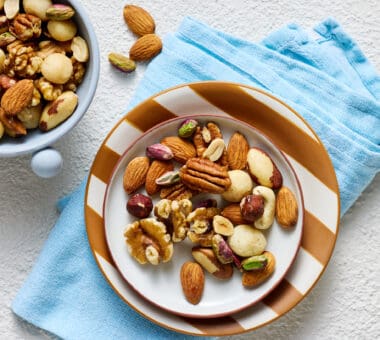
Long-term studies show that people who eat nuts regularly gain less weight over time (1). Understanding of body weight regulation…
Be sure to follow us for great recipes,
Nut inspirations and fun facts
For up to date information & the latest research articles