New international food pyramid

New international food pyramid
A first-of-its-kind international food pyramid, developed by 23 nutrition scientists from across the world, found there’s a lot of agreement on what healthy dietary patterns look like (1).
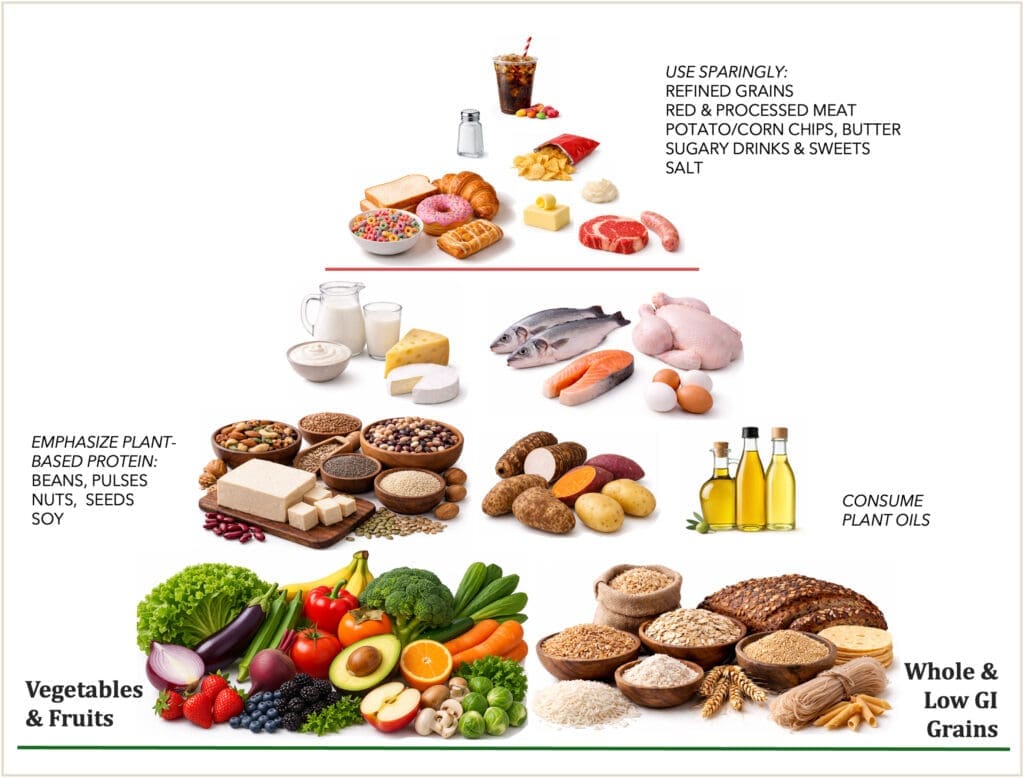
The International Food Guide Pyramid emphasises a plant-forward omnivorous dietary pattern, with food groups arranged according to their relative contribution to health-promoting dietary patterns.
It prioritises vegetables, fruits, whole grains and low-glycaemic index (GI) grain staples, plant-based protein sources, and plant oils, while limiting the consumption of red and processed meat, refined grains, and saturated fats.
Importantly, the pyramid provides a globally-adaptable approach to dietary guidance that incorporates both human and planetary health.
Summary of the pyramid’s components:
- Vegetables and fruit, alongside whole grains and traditional lower GI staple carbohydrates form the foundation.
- Plant protein sources (including legumes, pulses, nuts, seeds and soy foods) get the spotlight, as the primary protein foods within the dietary pattern – to be chosen more often than animal-based sources.
- Nuts, seeds and unsaturated plant oils (like olive and canola oil) are recommended as primary fat sources, with animal-based fats (such as butter, lard and beef tallow) to be limited.
- Fish, poultry, eggs and dairy in the middle – with modest intakes part of a healthy dietary pattern.
- Refined grains, red and processed meat, sugars consumed in low-nutrient forms (particularly sugar-sweetened drinks), and foods high in saturated fat and sodium are to be used sparingly.
The researchers also outlined three guiding principles supporting the pyramid:
- Emphasize plant-based foods as the foundation of healthy eating
- Choose foods rich in unsaturated fats over those high in saturated fats
- Prioritise high-quality carbohydrate sources.
Figure 1: International Food Guide Pyramid
Source: Della Corte, KA., et al. Toward international dietary guidance: A food guide pyramid for human and planetary health. Advances in Nutrition, 2026. 100738. https://doi.org/10.1016/j.advnut.2026.100738
The pyramid conveys a hierarchy of major food groups within an overall dietary pattern, rather than rigid intake targets or prescribed serves, and frames health effects in terms of what foods replace others – an approach supported by a substantial body of evidence (2).
In this way, it is flexible across different populations worldwide. And it can be adapted across different dietary contexts, including vegetarian, vegan, pescatarian, and culturally-specific dietary patterns.
The pyramid prioritises foods that are nutrient-dense, traditional, and culture-based while minimising nutrient-depleted foods. And while it emphasises plant-based proteins, it doesn’t exclude animal proteins.
It also places an emphasis on carbohydrate quality, by focusing on whole grains, high-fibre and/or low-GI carbohydrate foods, while limiting low-nutrient forms, such as refined grains and sugar-sweetened beverages.
Importantly, the researchers say its principles should be considered in the context of cultural diversity and regional food systems.
Did you know? Few Australians eat enough plant-based protein foods, including nuts, to reap their benefits (4-6). Elevating nuts in the Australian Dietary Guidelines – as important to eat every day, at a minimum of 30g daily – would help shift this.
What informed the pyramid’s development?
The pyramid was developed by the International Carbohydrate Quality Consortium, comprised of leading nutrition scientists from across Europe, Canada, the United States, and Australia.
They used quantitative intake targets from the EAT-Lancet Commission reference diet to inform the relative visual proportions of food groups in the pyramid. And their guiding principles were derived from converging evidence across dietary guidelines from multiple regions worldwide, high-quality evidence syntheses, and expert consensus.
The review article, recently published in the journal Advances in Nutrition, describes the first international food pyramid designed to reflect scientific agreement across multiple countries and cultures.
Did you know? The EAT-Lancet Commission identifies nuts and legumes – including pulses and soy – as central protein sources within a healthy, sustainable diet, complemented by small amounts of animal-source foods.
Putting the International Food Guide Pyramid principles into practice
Professor Della Corte, a nutrition scientist involved in developing the pyramid, suggested the following practical ways to apply its principles:
- Choose beans, peas, lentils, fish, poultry or yogurt more often than red and processed meats, and don’t make meat the biggest part of a meal.
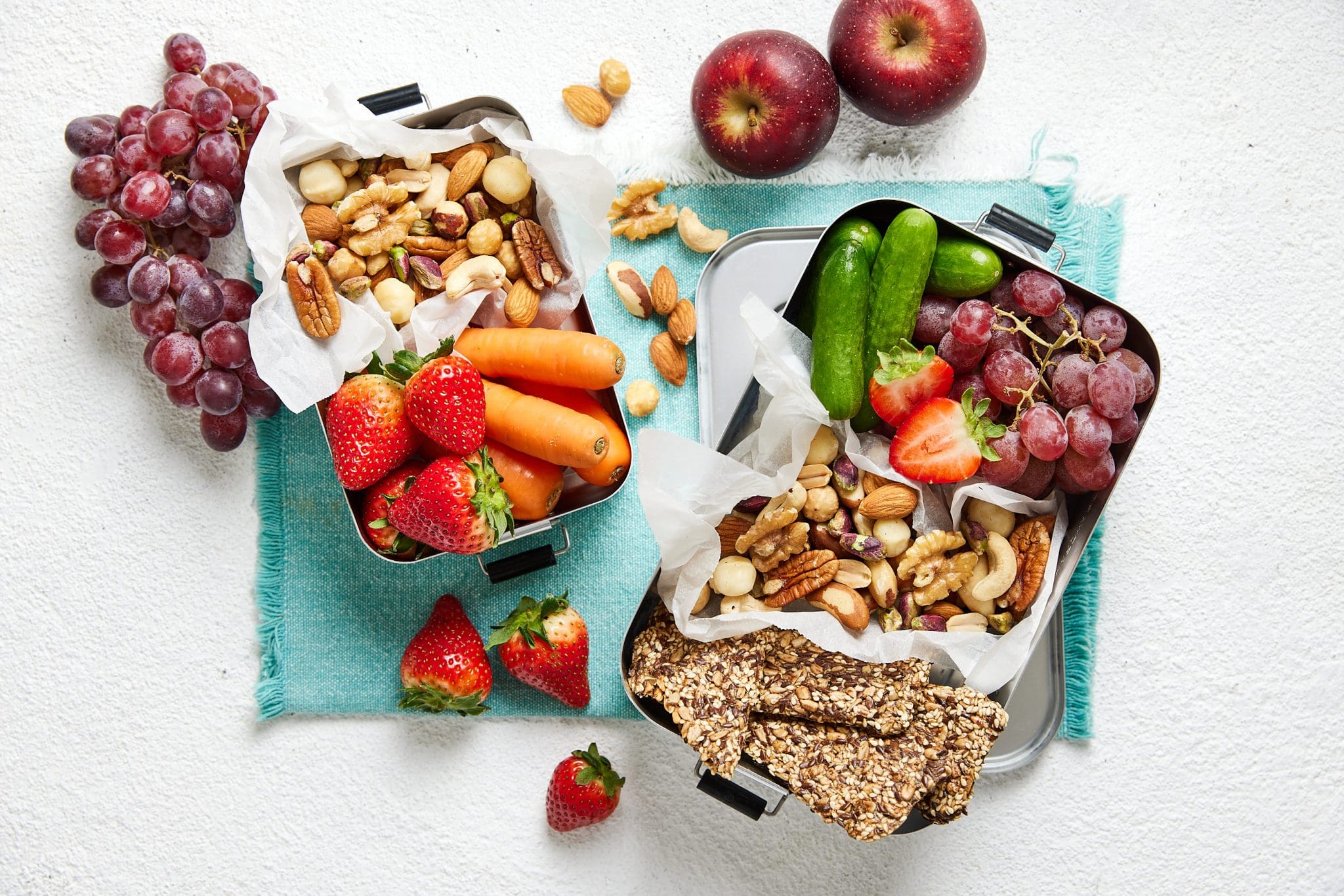
- Choose snacks such as nuts, seeds, fruit or vegetables with hummus instead of less nutritious processed snacks.
- Choose whole-grain bread over refined white bread and whole-grain or high-fibre cereals over refined, puffed, flaked or popped cereals.
- Cook with canola or olive oil instead of animal fats such as butter or tallow.
- Drink water or sugar-free sparkling water instead of sugary soda.
The bottom line:
The evidence-informed International Food Guide Pyramid, grounded in scientific consensus, offers a simple visual guide to a healthy dietary pattern. It could help people around the world better understand what a healthy diet looks like, inform public policy development, and support global efforts to improve both human and planetary health.
Written by the Nuts for Life dietitians, 10 November 2026
References
- Della Corte, KA., et al. Toward international dietary guidance: A food guide pyramid for human and planetary health. Advances in Nutrition, 2026. 100738. https://doi.org/10.1016/j.advnut.2026.100738
- Schwingshackl, L., Schlesinger, S. An international food guide pyramid: Dietary substitution, carbohydrate quality, and the need for methodological rigor. Advances in Nutrition, 2026. 100743. https://advances.nutrition.org/article/S2161-8313(26)00157-2/fulltext
- Ridoutt, B., Baird, D., & Hendrie, G. The importance of protein variety in a higher quality and lower environmental impact dietary pattern. Public Health Nutrition, 2022. 25(12):3583-8.
- Hendrie, GA., et al. Towards healthier and more sustainable diets in the Australian context: Comparison of current diets with the Australian Dietary Guidelines and the EAT-Lancet Planetary Health Diet. BMC Public Health, 2022. 22:1939.
- Nikodijevic, CJ., et al. Nut consumption in a representative survey of Australians: A secondary analysis of the 2011-2012 National Nutrition and Physical Activity Survey. Public Health Nutr, 2020. 23(18):3368-78.

For information purposes only. ©2026 Nuts for Life