New research: December 2025

New research: December 2025
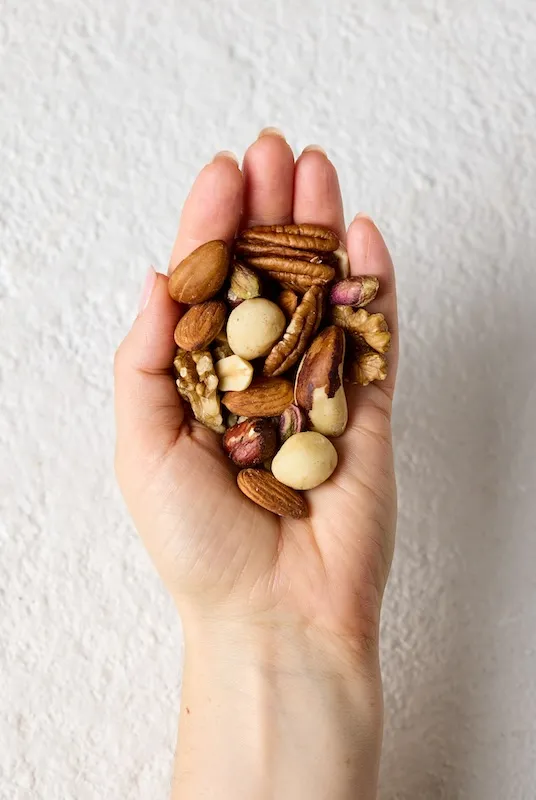
The body of evidence about nuts and health continues to grow. These local and international research papers, recently published, corroborate decades of research about the importance of a regular handful of nuts in a healthy diet.
Consuming tree nuts daily as between-meal snacks reduces food cravings and improves diet quality in American young adults at high metabolic syndrome risk. (Lillegard et al, 2025).
This 16-week, single-blind, parallel-arm randomised trial compared snacking on mixed tree nuts with snacking on typical high-carbohydrate foods, with portions matched for calories. The study included 84 young adults (ages 22–36) who had at least one metabolic syndrome risk factor. Researchers measured food cravings, hunger and fullness, and overall diet quality at baseline and after 16 weeks. It found that replacing common high-carbohydrate snacks with a daily handful (33.5 g) of mixed tree nuts reduced food cravings and the frequency of intake of high-sugar and fast-food items (such as pizza, cookies, and brownies), while improving overall diet quality. Participants who ate nuts also had significant increases in average total ghrelin and total GLP-1 levels at 16 weeks.
Update on tree nut and seed allergies: Prevalence, clinical characteristics, diagnosis, and management. (Jeong et al, 2025).
This paper offers an overview of tree nut (TN) and seed allergies, which it describes as rising globally. Precision diagnostics is said to better distinguish clinically-relevant allergy from sensitisation – helping guide selective avoidance, targeted challenges, and preparedness with epinephrine. The researchers say patient-centered care that supports inclusion of tolerated nuts, along with education and safety in high-risk settings, can reduce harm without unnecessary restrictions. They say oral immunotherapy for selected TNs and sesame is promising, yet key gaps remain in optimal protocols, long-term outcomes, cross-desensitisation, and the management of multi-sensitized patients.
Longer-term skin-roasted peanut consumption improves brain vascular function and memory: A randomized, single-blind, controlled crossover trial in healthy older adults. (Kerkhof et al, 2025).
This study, from Maastricht University Medical Centre in the Netherlands, suggests that eating two daily servings of peanuts may help support brain health in older adults. The randomised, single-blind, controlled crossover trial, included 31 healthy participants who consumed 60g/day of unsalted, skin-roasted peanuts, or no peanuts (control) for 16 weeks, separated by an 8-week washout period. Researchers found that peanut intake increased cerebral blood flow in regions linked to memory and cognition. While not a treatment for cognitive decline, the results suggest that regular peanut consumption may help support brain function over time, with improvements in brain vascular function in older men and women.
Nutrient adequacy and environmental foot-print of Mediterranean, pesco-, ovo-lacto-, and vegan menus: A modelling study. (Alcalá-Santiago et al, 2025).
This study compared the nutritional adequacy and environmental impact of four 7-day dietary models: a Mediterranean omnivorous diet, two vegetarian-style diets, and a vegan diet. All menus provided similar macronutrient levels and met most micronutrient requirements, although all were low in vitamin D, iodine, and omega-3s, with the vegan diet also low in vitamin B12. Environmental footprints consistently decreased from omnivorous to vegan diets, with notable reductions in CO₂ emissions, water use, and land use. The findings show that well-planned plant-based diets can be both nutritionally adequate and more sustainable, though some micronutrients require careful attention.
Higher adherence to (poly)phenol-rich diet is associated with lower CVD risk in the TwinsUK cohort. (Li et al, 2025).
This long-term study, involving more than 3,100 adults from the TwinsUK cohort, found that diets high in certain polyphenol-rich foods – such as berries, tea, coffee, nuts, and whole grains – were associated with healthier blood pressure and cholesterol levels, resulting in lower predicted cardiovascular disease (CVD) risk. Researchers examined both a polyphenol-rich dietary score (PPS-D) and its corresponding urinary metabolic signature (PPS-M), showing that people who consistently consumed more polyphenol-rich foods had a more favourable heart-health profile. They also emphasise the need for future dietary intervention studies in this area.
A combined MeDi-DASH-CHH dietary intervention improves lipid profiles and enhances dietary adherence in northern Chinese older adults with dyslipidemia: A randomized controlled trial. (Wu et al, 2025).
In this study, researchers developed a diet combining elements of the Mediterranean, DASH, and Chinese Healthy Heart (CHH) diets to assess its effects on blood lipid levels (particularly LDL-cholesterol) in older adults with dyslipidemia in northern China. A total of 210 adults aged 60-75 years were randomised to either a 6-month MeDi-DASH-CHH intervention or a control group (following standard dietary guidance from the 2024 Dietary Guidelines for Chinese Residents). The intervention group showed improvements in lipid profiles, compared with the control group (all P < 0.05). Their dietary intake also shifted toward more whole grains, potatoes, vegetables, fruits, aquatic products, dairy, and nuts, and less livestock meat, poultry, and eggs.
Effectiveness of Mediterranean Diet for the primary prevention of cardiovascular diseases: A systematic review and meta-analysis featured in the Italian National Guidelines “La Dieta Mediterranea”. (Volpe et al, 2025).
This systematic review and meta-analysis evaluated the effectiveness of the Mediterranean diet (MD) in the primary prevention of cardiovascular diseases (CVDs). It included 87 studies, with more than 1.4 million participants. Higher adherence to the MD was consistently linked to lower risks of peripheral artery disease (hazard ratio (HR) from 0.34-0.54), coronary heart disease (HR 0.95), atrial fibrillation (HR 0.65), cerebrovascular disease (HR 0.97), hypertension (HR 0.97), and CVD mortality (HR 0.97). Even a one-point increase in MD adherence score provided a significant protective effect. Overall, this suggests that the MD is an effective strategy for primary CVD prevention, and supports including MD-based recommendations in national dietary guidelines and public health initiatives.

For information purposes only. ©2026 Nuts for Life