Study: Using chestnut flour in bread may improve post-meal glucose responses

Study: Using chestnut flour in bread may improve post-meal glucose responses
A new Australian study has found swapping out some wheat flour for chestnut flour in bread can significantly lower post-meal blood glucose levels (1).
It found that replacing 50% of wheat flour with chestnut flour reduced the postprandial glucose response by 27%, despite both breads providing the same amount of carbohydrate.
The time it took for insulin to peak was also 24 minutes earlier with the chestnut-enriched bread, compared with the standard wheat bread.
The findings support the potential of chestnut flour as a useful ingredient for improving glycaemic control.
About the study
Following an overnight fast, 14 healthy Australian adults ate isocaloric meals providing 50g available carbohydrate as either chestnut flour-enriched bread (50% chestnut flour/50% wheat flour) or control bread (100% wheat flour).
Glucose and insulin were measured at baseline and then across a 3-hour period after eating.
Chestnut flour-enriched bread significantly reduced the glucose incremental Area Under the Curve (the increase in blood glucose levels over time) by 27%, compared with control bread. Specifically, glucose concentrations were 16% lower at 120 minutes and 14% lower at 150 minutes.
Total insulin exposure did not differ between the meals, but chestnut enrichment reduced the insulin peak time by around 24 minutes.
The study authors highlight that an early insulin release, such as this, may help to suppress glucose production by the liver, help the body dispose of glucose more efficiently, and blunt the early rise in blood glucose after eating.
The addition of chestnut flour boosted the fibre content of the bread by around three-fold, compared with the 100% wheat bread. And the total polyphenols were around 22% higher in the chestnut-enriched bread.
Figure 1: Visual Abstract
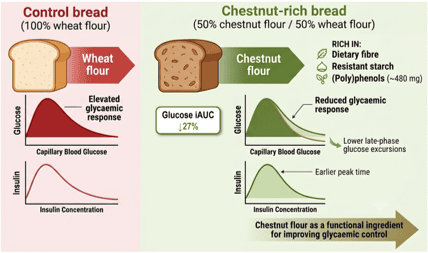
Visual abstract from: Chestnut flour-enriched bread reduces postprandial glycaemic response in healthy adults: A randomised, controlled crossover study. Food Funct. 2026;17(19):8795-807.
What does this mean in practice?
Changing how staple foods, like bread, are formulated can play a role in improving metabolic health.
Ingredient substitutions, like partially swapping in chestnut flour for wheat flour in bread, alters the food matrix, fibre, resistant starch and polyphenol content – and as a result, has the potential to improve glycaemic control.
For health professionals, this study is a reminder that the body’s post-prandial glucose and insulin responses are influenced by more than just carbohydrate content alone.
How might chestnut flour impact blood glucose?
Chestnut flour contains more dietary fibre, resistant starch and polyphenols than refined wheat flour. These components may help slow carbohydrate digestion and glucose absorption after eating.
- Food matrix: Adding chestnut flour alters the starch structure, the physical structure and the fibre content of bread, all of which affect how quickly it is digested.
- Polyphenols: These natural plant compounds, found in chestnut flour, influence carbohydrate digestion and how the body processes glucose.
- Dietary fibre: Insoluble fibre, soluble fibre and resistant starch can slow digestion and help reduce rapid blood glucose rises. And their fermentation by gut bacteria, to produce short-chain fatty acids, may also support long-term blood glucose regulation.
However, further studies are needed to assess the longer-term effects of using chestnut flour in this way, test different forms and proportions of chestnuts, and confirm the mechanisms responsible for such findings.
Did you know? Unlike other tree nuts, which are characterised by higher amounts of proteins and healthy fats, chestnuts are mainly composed of starch and fibre, and also contain vitamins E and C, minerals such as potassium, phosphorus, and magnesium, and polyphenols.
The randomised crossover trial, recently published in the scientific journal Food & Function, is the first to examine the effects of whole chestnuts, incorporated into bread as flour, on postprandial glycaemic responses in healthy adults.
The bottom line:
Exploring how everyday foods, like bread, are formulated may be one way to advance food-based strategies for improving metabolic health. These study findings suggest a potential role for chestnuts, as chestnut flour, in modulating post-prandial blood glucose levels. Further research is needed in this area to determine how the findings may meaningfully impact longer-term health.
Written by the Nuts for Life dietitians, 5 November 2026
References
- Houghton, MJ., et al. Chestnut flour-enriched bread reduces postprandial glycaemic response in healthy adults: A randomised, controlled crossover study. Food Funct., 2026. 17(19):8795–807.

For information purposes only. ©2026 Nuts for Life